
- May 6, 2026
- Posted by: Admin HRCommunity
- Category: Blog
What powers high-performing teams? How are those shaped, strengthened and transformed? Can technology be a game-changer or is the secret in something more subtle? As an Agile Coach, I’ve spent years exploring what truly enables teams to thrive, especially in times of uncertainty and change. In this article, I’ll share the magic formula I’ve discovered – the invisible forces that drive team transformation.
The Magic Behind High Performance
Having worked with 20+ international cross-functional teams on 20+ projects over the past 15 years, I’ve developed and applied the “Ramp-Up Your Teams” Coaching Model that resulted in 3.7X higher delivery and 2X higher predictability rates over a 1-2 years’ timespan. It also demonstrated growing and/or sustainable annual team health levels. I called this Magic in Action.
In my journey I discovered the only one “guilty” that can either kill or create this Magic. It’s our Brain—and the 3 states it cycles through.
Understanding the Team Journey
Before diving into these states, let’s recall the well-known stages every team goes through and what it experiences at each:
- Forming: Enthusiasm and exploration
- Storming: Conflicts
- Norming: Cohesion
- Performing: Value creation
- Adjourning : Uncertainty
Uncertainty I noticed a clear pattern of how our brain acts at each stage. It almost always loops through the following 3 states: Resistance, Pressure, Boredom.
Here is how this looks like:
1. Resistance → Storming stage
2. Pressure → Norming stage
3. Boredom → Performing stage
Keep calm! You usually won’t meet these 3 states at the team Forming stage. However, my advice is to seize the momentum and build trust at team onset: analyze communication styles, work preferences and measure chemistry within the team when it just starts off.
Brain State: Resistance (Storming Stage)
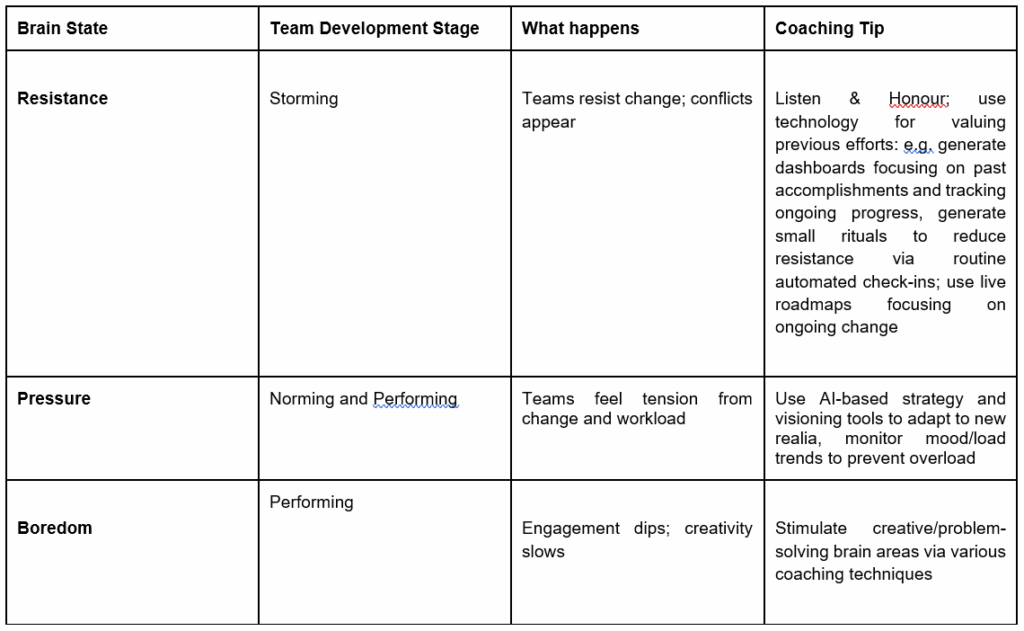
Even the most experienced coaches would agree that no change comes without resistance. Teams resist when they fear anything new may ignore whatever was done before, in other words their past efforts will be devalued. During this stage, conflicts may appear, and progress can stall.
The key? The coach should take the position to: “Listen and honour”. When skillfully dealt with, the brain is no longer threatened and opens up to new knowledge. Also, promoting consistent small rituals helps the brain “put down its armour” and start forming habits.
How technology helps:
- Honour the efforts team has already made via dashboards showing current standing, past accomplishments and ongoing progress
- Establish mini-rituals of communication via automated, personalized daily check-ins that help form habits and subtly recognize and get accustomed to ongoing dynamic changes
- Use live roadmaps for planning changes and collaboration
These interventions help teams adapt without feeling overwhelmed or devalued.
Brain State: Pressure (Norming & Performing Stages)
During the norming stage, where business processes are up and running and teams are learning to collaborate with each other, almost always there is a condition, be it within the system or outside, that turns on an alarm. Imagine, for example, a change in top-management that brings in new demands and dissatisfaction with the current state of things or a new regulation that impacts the way the system works inside. Change inevitably creates pressure. Under such conditions habits that the teams have previously formed may stop working.
The trick here is to help teams reshape pressure into development alternatives, i.e. helping teams to re-think the existing way of running things.
How technology helps:
- Use technology-based strategy and visioning tools during 1:1s with those directly affected by pressure as well as during sessions with key stakeholders aimed at adapting the vision to the new reality
- Help your teams recognize and analyze their everyday/monthly mood and workload trends
- Promote early escalation to prevent pressure from snowballing to keep the teams productive and motivated
Brain State: Boredom (Performing Stage)
Imagine threats and pressure are stabilized, teams are performing, profits are growing, time-to-market decreases and users are satisfied. Looks like a paradise, right? Wait! The third “Impostor” is around the corner: the “Boredom”. This is when teams might start procrastinating unless new challenges are introduced. Here the Coach uses techniques that stimulate parts of the brain in charge of creativity and future-oriented solutioning (e.g. Disney strategy, “3 Hats, 3 Chairs”) and many others.
It is at that moment when our brain transitions from its “guilty” state to its “miraculous” state and expands to its nearest growth zone where most of the miraculous solutions and decisions lie! Creativity and Motivation take over!
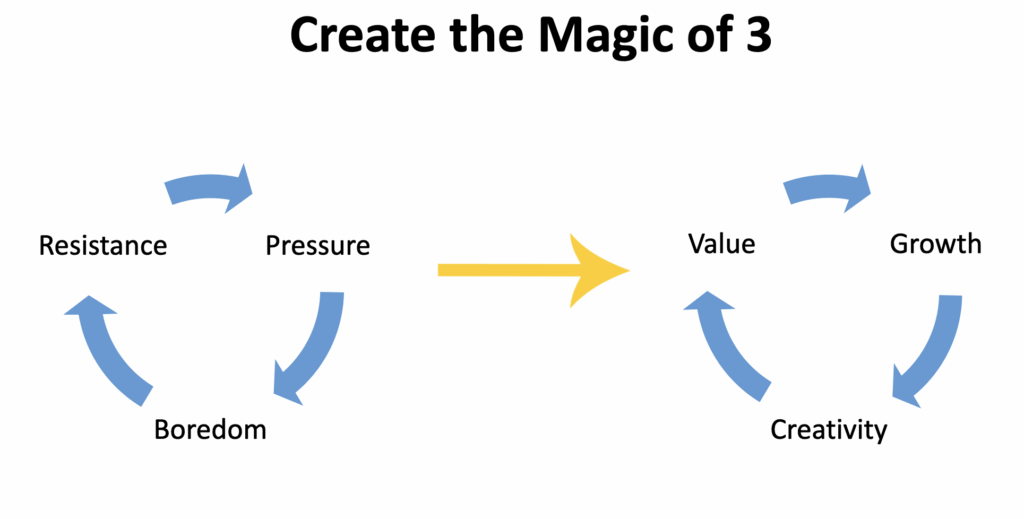
So, when we tame OUR BRAINS and ITS STATES we create Magic within teams, switching the Resistance, Boredom, Pressure loop into Value, Growth, Creativity loop (as illustrated below).
The Role of Leadership
While technology offers immense potential, our brains love another secret ingredient, which is human-centricity equally essential at all team development stages. While running leadership schools for management and teams I focus on trust, motivation, and self-organization. This not only helps navigate through changes but also supports management decisions that focus on unpacking human potential, which in turn generates a ripple effect of generating Value, Growth and Creativity.
Can Technology Be a Game-Changer?
Let me answer this way: We can dance Flamenco without Castanets but we cannot feel the fire of the dance without emotions!
Conclusion
When we understand how our brain operates at different team development stages we unlock the kind of magic within teams that lasts in times of change. By combining technology with human-centric leadership, we can help teams thrive, innovate, and reach new heights, especially in times of uncertainty.
I invite you to embrace this journey, explore the invisible powers at play, and never stop growing.
Are you ready to explore the invisible powers within your teams?
______________________________________
Appendix: Coaching tips and tools adapted for each team development stage:
Article Author: Yulia Shahnazarova
DisruptHR Yerevan 2025